When Everything Fell Apart, the Songs Finally Told the Truth
There's a particular kind of creative paralysis that shows up right after something goes sideways in your life. The job disappears. The relationship ends. The record deal falls through. The health scare lands. And suddenly, the last thing you want to do is sit down at the piano or pick up the guitar, because everything you touch feels too raw, too real, too close to the bone.
Here's the thing nobody tells you in that moment: that rawness is the work.
The songs that have genuinely moved people — the ones that make strangers feel less alone at 2 a.m. — almost never came from a comfortable afternoon with nothing on the line. They came from someone who had no other way to process what was happening to them. They came from necessity.
If you're in the middle of a rough stretch right now, I want to offer you a different frame for it.
The Creative Cost of Playing It Safe
Most of us spend a lot of time making art that protects us. We write around the hard stuff. We hint at the pain without actually going there. We keep the chorus vague enough that nobody can really pin down what we mean. And there's nothing wrong with that — sometimes metaphor and distance are exactly the right tools.
But there's a ceiling on work that's always playing defense.
When you're in a genuinely difficult season, that ceiling gets blown off. The usual filters — what will people think, is this too personal, will this embarrass me — they go quiet. Not because you've suddenly become brave, but because you're too tired to keep them running. You just start writing what's actually true.
That's when the good stuff happens.
Struggle Doesn't Guarantee Art — But Attention Does
Let's be honest here, though. Going through something hard doesn't automatically produce great creative work. Plenty of people have terrible years and come out the other side with nothing to show for it artistically. Pain alone isn't the ingredient. Paying attention to the pain is.
This is where the practical side comes in.
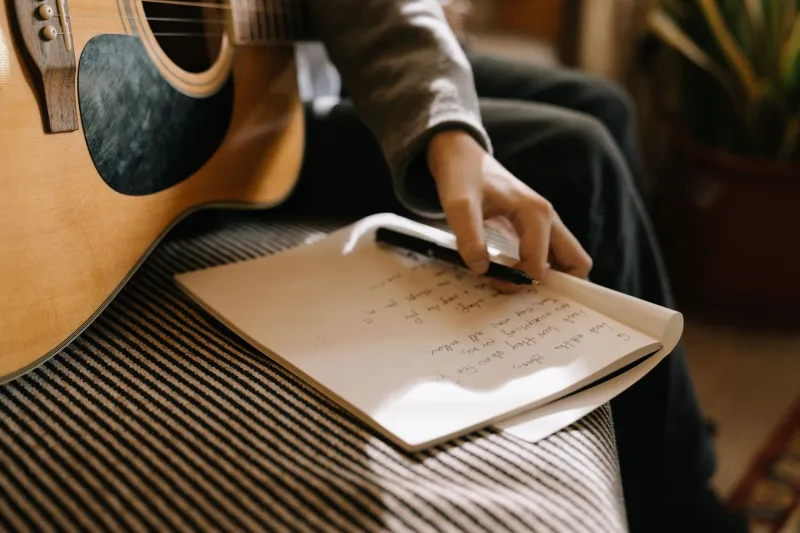
When you're in the thick of a difficult season, keep a voice memo habit. Not to make finished songs — just to capture whatever's rattling around in your head. The half-sentence you said out loud while driving. The weird image that kept coming back to you. The thing you almost texted someone but didn't. These fragments are your raw material, and they're perishable. If you don't catch them, they evaporate.
The same goes for notebooks. Keep one close. Not a fancy journaling practice — just a place to dump what's happening without editing it. You're not writing for an audience yet. You're writing to stay in contact with your own experience.
The Distance You'll Need (And When It Arrives)
Here's something worth understanding about turning difficult seasons into art: most of the time, you can't do the finishing work while you're still inside the experience. You can capture it. You can draft it. But the shaping, the editing, the decisions about what to keep and what to cut — that usually requires a little distance.
This is actually good news. It means you don't have to have it all figured out right now. Your job in the hard season is just to collect. To notice. To not let the raw material slip away.
The album that comes from your worst year often gets made in the year after. When you can look back at those voice memos and fragments with enough perspective to see what they're actually about. That's when the structure emerges. That's when the through-line reveals itself.
Some artists call this the lag. You live it first, then you make it later. Respecting that lag — not forcing the finished work before it's ready — is one of the quieter disciplines of a creative life.
Rejection Is a Specific Kind of Fuel
If your hard season involves creative rejection specifically — a label pass, a bad review, a project that flopped, an opportunity that went to someone else — there's an extra layer worth sitting with.
Rejection has a way of clarifying what you actually care about.
When something you made gets dismissed or overlooked, your first instinct might be to make yourself smaller. To sand down the edges. To figure out what they wanted and give them that next time. And sometimes there's useful feedback buried in rejection — it's worth separating the signal from the noise.
But often, the most useful response to rejection is to go deeper into what makes your work yours. The things that got you passed over might be exactly the things that will eventually set you apart. The creative instincts that feel too weird, too specific, too personal — those are frequently the ones worth doubling down on.
The music industry is full of artists who got told no until they made the record that couldn't be ignored. That record almost always sounds like them, not like whatever they thought the market wanted.
Permission to Make the Difficult Thing
If you take one thing from this, let it be this: you don't need to wait until your life is smooth to make meaningful work. You don't need to be okay first. You don't need to have processed everything and arrived at some tidy conclusion before you're allowed to sit down and create.
The difficult season is valid source material right now, exactly as it is.
Some of the most enduring songs in American music — from the Delta blues to Appalachian folk, from soul records cut in the middle of the civil rights movement to the heartbreak country that defined Nashville — were made by people who had no luxury of waiting until things got easier. They made what they had, with what they had, when they had it.
You can do that too.
The worst year of your life might be the one that gives your creative work its backbone. Not because suffering is noble — it isn't, and nobody should romanticize it. But because honesty is powerful, and sometimes it takes a hard season to finally stop hiding behind anything else.
Start capturing. Start drafting. Let it be messy and unfinished and too close to the truth.
The album can come later. Right now, just don't let the material get away.